
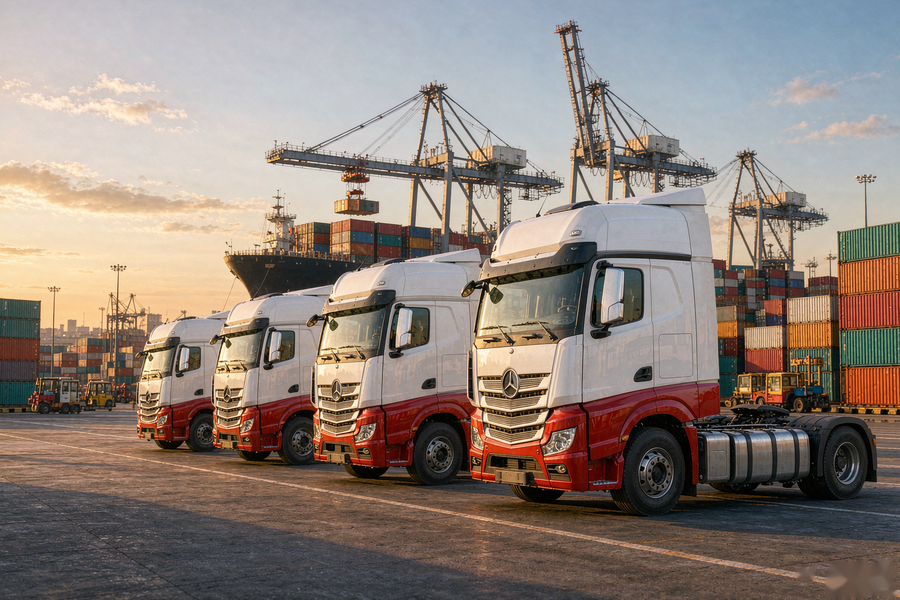
Exports have become the engine room of China’s heavy-truck industry. Brokerage research estimates third-quarter 2026 heavy-truck exports at about 130,000 units, up 34% year on year, even as domestic wholesale volumes slipped 3%. At Shandong Heavy Industry’s investor open day, export champion Sinotruk (CNHTC) said its full-year heavy-truck exports are expected to exceed 200,000 units, while Foton reported January–October exports above 189,000 vehicles, up 43.4%. From African market share records to a surge of trucks crossing into Vietnam, the past week’s announcements confirm that overseas demand — not the home market — is setting the pace.
Export data: a 34% jump in Q3, with Africa and Southeast Asia leading
According to brokerage research cited by financial-media digest CFi.cn, China exported about 130,000 heavy trucks in the third quarter of 2026, up 34% year on year. Africa and Southeast Asia were the main incremental markets, with shipments to Africa up 54% and to Southeast Asia up 9% year on year. In contrast, industry-wide wholesale volumes fell 3% over the same period, underlining that exports have become the sector’s decisive growth pole while the domestic market remains under pressure.
The same research reiterates that Sinotruk holds the No.1 position in China’s heavy-truck export market share, benefiting from deep overseas channels and improving product strength, with relatively resilient gross margins despite industry-wide profit pressure.
Note on data caliber: the quarterly figure above comes from brokerage analysis of customs (HS-code) statistics, a caliber that may include some medium- and light-duty trucks. Figures from the China Association of Automobile Manufacturers (CAAM), which uses a narrower truck classification, can differ by several percentage points. Both calibers are labeled where used in this report.
Sinotruk: 200,000 export units targeted for 2026, and a 21-year reign at the top
At the Shandong Heavy Industry Group 2026 investor open day held in Jinan, management disclosed a set of export numbers that frame the whole industry’s trajectory:
- In January–September 2026, Sinotruk sold 390,000 vehicles worldwide, up 19.3%, of which 182,000 went to international markets, up 52% year on year — the group’s 21st consecutive year as China’s No.1 truck exporter.
- For full-year 2026, Sinotruk’s heavy-truck exports are expected to exceed 200,000 units, with overseas localized production approaching 50,000 units.
- Sinotruk sold 37,000 new-energy heavy trucks in January–September, up 139%, moving to the top of the domestic NEV heavy-truck market; group-wide, NEV heavy-truck sales had already passed 70,000 units by the end of October.
- Management said Chinese brands’ share of Africa’s heavy-truck market has climbed from 80% in 2024 to about 89% this year, and in Southeast Asia from 48% to about 70%.
- Group export revenue for 2026 is expected to exceed RMB 125 billion, and Sinotruk has set a 2030 target of 800,000 vehicles and revenue above RMB 300 billion.
Beyond the emerging-market strongholds, Sinotruk products are now shipping in volume to Australia and New Zealand, and the company is working with Austria’s Steyr on European localized production — a signal that Chinese heavy-truck makers are pushing upmarket into regulated, brand-sensitive markets, not just price-driven ones.
Foton: 189,000 vehicles exported in ten months, and a system — not just trucks — going overseas
Foton’s October production-and-sales bulletin, filed in early November, showed exports of more than 21,000 vehicles in October (+41.4% YoY) and cumulative January–October exports above 189,000 units, up 43.4% — roughly 40% of the company’s total sales. New-energy momentum is even sharper: October NEV sales exceeded 15,000 units, up 91.3%, with January–October NEV sales above 110,000 (+34.2%). Heavy-truck sales reached 136,000 units in the ten months, up 16.1%.
The company’s overseas model is shifting from vehicle exports to full-chain localization: 32 localized plants worldwide (with Brazil, Thailand and South Africa now in volume production), dual domestic-overseas R&D centers, its own ocean-shipping capacity, and a network of 1,200+ sales and 1,500+ service outlets covering more than 140 countries. In October the company inaugurated its Africa Regional Training Center and hosted an Africa partner conference bringing together some 700 partners from 42 countries, where multi-country thousand-unit-class heavy-truck deliveries and localized-manufacturing agreements were signed. Foton says it is on course to close the year near its 200,000-unit overseas sales target.
Specialty vehicles are joining the wave: More than 1,000 Foton Puroko (Auman-brand) sanitation vehicles — the company’s largest-ever single overseas order — departed Changsha, custom-built for coastal-humid and high-temperature operating conditions abroad.
Cross-border logistics is becoming a competitive weapon: Vietnam and the bonded-zone express lane
The delivery story of the week came from the China–Vietnam border. Under Dongxing Customs supervision, 73 Sinotruk off-road mining dump trucks — worth more than RMB 42 million — crossed the Beilun River II Bridge into Vietnam. The vehicles are oversize units (4.37 m high, 3.36 m wide), and the customs house opened a dedicated channel with document pre-review, staged arrival and consolidated inspection to clear them same-day. In the first ten months of 2026, more than 3,750 commercial vehicles were exported through Dongxing, a 3.1-fold increase year on year, with batches of over 100 units crossing in a typical week.
In Shaanxi, SHACMAN (Shaanxi Automobile) is using the Xi’an Guanzhong comprehensive bonded zone to compress its export cycle: goods entering the zone can claim export VAT refunds immediately rather than waiting for physical departure, and a “one declaration, multi-vehicle” clearance mode has raised gate throughput by about 70%. Since the bonded-zone tractor-truck export project started in June 2026, cargo value out has already exceeded RMB 260 million. SHACMAN’s January–September export sales reached RMB 13.5 billion, up 13.4%, with the company pressing deeper into the Middle East and Africa.
Policy watch: NEV export tax rebates to fall from 13% to 9%
One recent policy item will shape export economics into next year: China’s Ministry of Finance and State Taxation Administration have announced that from April 1, 2027, the VAT export rebate rate for new-energy vehicles will drop from 13% to 9%. Industry analysts expect the change to squeeze margins on NEV exports and raise the bar for cost control and localized operations — a shift that favors large, systematized exporters such as Sinotruk, Foton and SHACMAN, and could accelerate industry consolidation.
What it means for international buyers
- Scale is real and stable: with three major OEMs each exporting well over 100,000 vehicles a year, container and roll-on/roll-off capacity to Africa, Southeast Asia, Latin America and the Gulf is being booked at industrial scale — buyers can negotiate delivery windows, not just prices.
- Border and bonded-zone logistics now shorten lead times: same-day customs clearance at Dongxing and 70% faster bonded-zone throughput in Xi’an mean faster, more predictable delivery for land-border markets like Vietnam and Central Asia.
- Localization de-risks the lifecycle: 32 Foton plants, Sinotruk’s ~50,000 units of planned overseas localized production and expanding parts/training networks materially improve spare-parts availability and warranty support — verify the local service footprint in your market before signing.
- New-energy trucks are proven but buy with eyes open: NEV heavy trucks are scaling fast on the back of megawatt-charging and battery-swap programs; order before the April 2027 rebate cut shifts pricing, and require charging-infrastructure and acceptance criteria in contracts.